

Thailand's most reliable place to see elephants in the wild sits an easy afternoon up the coast. When to go, how the safari works, and what to expect.

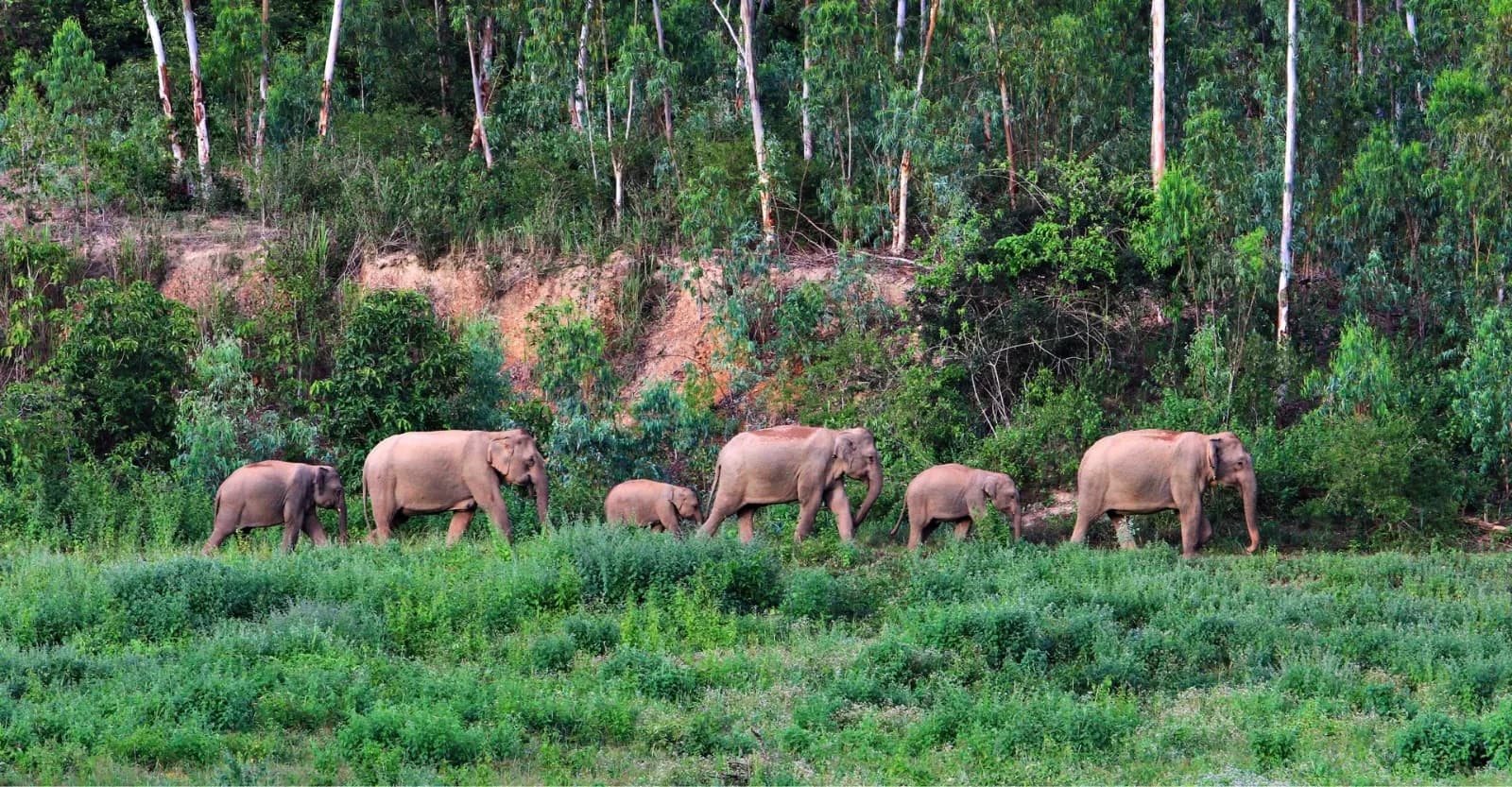
There's a particular half-hour at Kui Buri, late in the afternoon, when the heat finally lets go. The grass turns the colour of old gold, the shadows stretch long across the clearing, and somewhere along the treeline a grey shape steps out of the forest. Then a second one behind it, smaller. You sit very still on the back of the ranger's pickup and watch a family of wild elephants drift into the open to feed — unbothered, close enough that you can hear the soft tear of grass and the low rumble they use to talk to one another.
It's one of the last places in Thailand where you can see this: elephants living wild, on their own ground, behaving as though you simply weren't there. And the quiet luck of it, for anyone staying at the villa, is how close it all is — an easy afternoon out, a short drive up the coast and a turn inland into the hills.
Thailand's most reliable place to see wild elephants
Kui Buri National Park covers close to a thousand square kilometres of forest and mountain along the Tenasserim range, the band of high ground that divides Thailand from Myanmar. It was made a national park in 1999, in good part to protect one of the country's healthiest populations of wild Asian elephants — and today it's widely held to be the surest place in the country to see them. The park's own figures put the odds of a sighting at around ninety-five per cent. In a recent year, ninety-seven of every hundred afternoon trips came back having seen at least one elephant, and close to nine in ten saw gaur.
Those are extraordinary numbers for wild animals, and they didn't happen by chance.
A truce, not a show
The clearings you watch from were once farmland. For years there was a hard standoff here between the elephants and the people growing pineapple along the forest's edge — the elephants came down to raid the fields at night, crops were lost, tempers frayed, and now and then it turned fatal on both sides. The park's response was patient rather than forceful: restore the old clearings, plant the grasses and fruit the elephants favour, and keep the reservoirs topped up through the dry months, so the animals have every reason to stay up in the forest instead of wandering down into the villages. It worked. What you're really watching, on a good evening, is the result of that long, quiet work — not a spectacle laid on for visitors, but wild animals choosing to be there.
It's worth holding that in mind as you go. This isn't a zoo, an elephant camp, or a ride. Nobody is bathing or feeding these elephants. You are a guest at the edge of their evening.
When to go — late afternoon, every time
Go late in the day. If you remember one thing, remember that. The wildlife-viewing area opens at two o'clock and closes at six, and for the first hour or so very little stirs — the animals are still deep in the shade, waiting out the worst of the heat. Things begin to shift around half past three, and the final hour before the gates close, when the light drops and the air cools, is when the clearings come alive. Arrive early in that window and let it build.
Season matters too. The cool, dry months from November to February are the most comfortable and the most dependable, as the animals come down to the park's water. The green season has its own quiet charm — fewer people, fuller streams, the hills a deeper green — but a heavy afternoon shower can cut a viewing short, so leave yourself a little room to be flexible.
How the afternoon works
It's simpler than it sounds, and pleasingly low-tech. You drive to the park's visitor area, and everything is arranged there on arrival — you can't book it ahead, which trips up a few people who try. A park ranger and a local driver take you the last stretch to the Huai Luek viewing area, about sixteen kilometres in, on the back of an open pickup fitted with bench seats. No roof, no glass between you and the hills — just open air and a clear line of sight in every direction. The ranger knows where the herds have been moving, and will ease the truck up to the edge of a clearing, cut the engine, and wait.
There's a modest park entry fee plus a charge for the vehicle and guide, settled at the centre — bring cash, as cards aren't a sure thing. Allow three to four hours from arrival to the drive back out, and resist the urge to hurry. The best moments tend to find the people who sit still the longest.
What you'll actually see
Elephants are the headline, but they're not the whole of it. Kui Buri is one of the last strongholds of the gaur — the largest wild cattle on earth, heavy through the shoulder and surprisingly light on their feet, moving through the long grass in herds that can run to several dozen. There are banteng too, rarer and far shyer; wild boar rooting at the margins; barking deer; and, overhead at dusk, hornbills beating between the ridges in that heavy, unmistakable flight. Leopard and dhole live here as well, though you'd need a generous helping of luck to see either.
Bring binoculars. The animals keep their distance, as they should, and a decent pair turns a far grey smudge on the hillside into a moment you'll talk about over dinner.
Getting there from the villa
The viewing area lies inland, west of the main coast road, in the folds of hills behind Kui Buri town. From Hua Hin it's roughly an hour and a half to the south. From the villa it's closer still — a short drive north up the coast — which makes the late-afternoon timing easy to plan around. Leave after a slow lunch, give the golden hours to the elephants, and you're back on the terrace as the light goes, in good time for dinner by the pool. We can arrange a driver who knows the road; the turn inland from the highway is well signed, and the run out through the pineapple country is part of the pleasure of it.
A few quiet courtesies
- Keep your distance, and keep it calm. These are wild animals on their own ground. The rangers set the limits — follow them. No stepping down from the truck, no feeding, no calling out to draw an animal nearer.
- Bring the basics. Water, a hat, binoculars, and a long lens if you carry one. In the cool season the evenings turn fresher than people expect.
- Stay quiet. Sound carries a long way across an open clearing. The quieter your truck, the longer the animals stay.
- Come in the dry season if you can. Clearer afternoons, kinder roads, better odds.
There's something genuinely steadying about it — sitting on the back of a pickup as the day cools, watching a herd that has every reason to keep clear of people decide, for one evening, that you're no threat at all. It asks for patience and gives back something rarer in return.
Astral Villa sits on the beachfront at Ao Noi, a short drive down the coast from the elephants and the national park — which makes Kui Buri one of the easiest of the great days out to fold into a stay, and one of the few that sends everyone home quiet. When you're ready, check the dates and send an enquiry, and ask us about the afternoon run while you're at it. There's more to do around the villa than a single afternoon can hold.